




A first period rarely arrives on a convenient day. It turns up during a maths test, on a school trip to Kandy, at a cousin’s wedding, or halfway through a tuition class in a white uniform. For a lot of Sri Lankan girls, the fear is not the blood itself. It is the not knowing: what do I use, who do I tell, what if it leaks through and everyone sees? A simple first period kit in Sri Lanka takes most of that fear away before it starts.
This guide is for girls getting ready for their first cycle and for the mothers, aunts, akkas and fathers helping them. We will walk through what to pack, how much protection a beginner actually needs, how to handle school and nights, and how to talk about it at home without the whispering. Where we name products, they are ones you can order from period.lk with clear LKR prices.
Why a first period kit in Sri Lanka matters more than you think
Most girls get their first period somewhere between about 10 and 15, though a little earlier or later can still be normal. The first few cycles are often irregular. Flow can be light spotting one month and surprisingly heavy the next. That unpredictability is exactly why a kit helps: it means she is ready before she knows her pattern.
In Sri Lanka there is an extra layer. Many families still treat periods as something to hide, school toilets are not always clean or private, and a long bus ride home in the heat leaves little room for mistakes. A small, ready pouch in her school bag turns a possible panic into a two-minute fix in the washroom. It also sends a quiet message from the adults around her: this is normal, and we planned for it.
The real worries girls have about the first period
Before choosing products, it helps to know what girls are actually worried about. When we listen to young customers and their mothers, the same fears come up again and again:
- Leaking through a uniform or a light-coloured frock in class.
- Not knowing how to put on a pad, or which way it goes.
- Smell, and whether other people can tell.
- Cramps arriving at school with no one to ask for help.
- Night leaks on the bedsheet, especially when sharing a room.
- Feeling embarrassed to ask a father, brother or shopkeeper for pads.
A good kit answers each of these. It gives her reliable protection, a backup, a way to freshen up, and somewhere discreet to keep everything.

What to pack: a simple first period kit checklist
You do not need a cupboard full of products. A beginner kit works best when it is small enough to carry every day and simple enough to use without help. Here is what we suggest:
- Two to three changes of protection. Either pads, a period panty, or both. Beginners do well with one option they trust and one backup.
- A spare pair of underwear. If a leak happens, a clean pair fixes most of the problem.
- Panty liners. Useful for the light days at the start and end, and for spotting between irregular early cycles.
- Gentle intimate wipes. For a quick external freshen-up when the school toilet has no running water.
- A small zip pouch. So nothing falls out of a bag in front of friends.
- A sealable bag or newspaper. For wrapping used pads when there is no bin in the cubicle.
- A small note. A short reminder from mum of what to do, and who to call, can be surprisingly comforting.
If you prefer one checkout instead of building this item by item, the Healthfab First Period Essentials Kit (LKR 6,500) was put together for this exact moment. It combines reusable GoPadFree period panties, a disposable panty for travel or sudden days, and intimate wipes, so a first-timer has home protection, school protection and a no-wash backup in one box.
Pads, period panties or both for a first period?
This is the question parents ask most. The honest answer is that many girls start with a mix, then settle on what feels right after a few cycles.
Pads: familiar and easy to find
Pads are what most mothers in Sri Lanka grew up with, so they are easy to explain. Softer, rash-free pads matter for young skin, especially in humid weather. The Carmesi Sensitive Rash-Free Sanitary Pads (LKR 1,800) are a gentle option for girls who get itching or chafing on long school days.
Period panties: fewer things to get wrong
Period panties look and feel like normal underwear but have built-in absorbent, leak-resistant layers. For a nervous first-timer, that means no wings to fold, nothing shifting during sport, and no visible wrapper in her bag. A heavy-rated style such as the Healthfab GoPadFree Heavy Leakproof Period Panty (from LKR 2,250) gives her confidence on a day she does not yet know how heavy her flow will be. You can compare every style on our period panties page.
Why a combination works best at the start
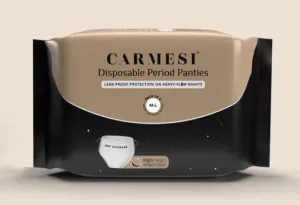
Many families use a period panty at home and overnight, and pads as the backup in the school bag. Others do the opposite. Either way, having two options means a single bad moment does not become a crisis. If washing is difficult on a particular day, such as an exam week or a trip, a pack of Healthfab Disposable Period Panties (LKR 1,690 for five) covers it without any laundry.
Handling school, tuition and sport
School is where most first-period stress happens. A few simple habits make a big difference:
- Keep the kit pouch in the school bag every day, not just when she expects her period.
- Change protection at the interval if using pads, even if it feels fine.
- Wear darker shorts or tights under a white uniform on the first heavy days.
- Tell one trusted teacher or friend, so she is never completely alone if something goes wrong.
- For PE and sport, a period panty or a well-fitted pad with wings stays put better than a loose pad.
Many girls also worry about smell. Fresh blood does not usually smell strong; odour mostly comes from leaving protection on too long. Regular changes and a quick wipe solve this, so there is no need for scented products on young skin.

Nights, sleepovers and the bedsheet worry
Night leaks are one of the most common first-period fears, especially in homes where a girl shares a bed or room with siblings. Lying down lets flow travel backwards, which is why ordinary day pads often fail overnight.
For nights, choose longer protection or a heavier period panty, and lay an old towel on the bed for the first few cycles so she can stop worrying and actually sleep. If overnight comfort becomes the main problem, Healthfab GoPadFree Period Sleep Shorts (LKR 5,090) give fuller coverage than a brief, which helps restless sleepers.
Cramps, mood and when to see a doctor
Mild cramps, tiredness, a sore lower back or feeling a little emotional in the days before a period are all common. A hot water bottle on the tummy, gentle stretching, staying hydrated and a proper rest usually help.
It is worth seeing a doctor if the pain stops her going to school regularly, if she is soaking through protection every hour or two, if bleeding lasts much longer than a week, or if periods have not started at all by around 15 or 16. These are not reasons to panic, just reasons to get proper advice instead of suffering quietly.
How to talk about the first period at home
The kit is only half of it. The other half is the conversation. In many Sri Lankan homes, periods are still described with hints rather than words, and some girls are told to stay away from the kitchen or temple. Whatever your family’s traditions, a girl does better when she knows clearly what is happening to her body and that she will not be shamed for it.
- Talk early, before it happens, so it is not a shock.
- Use the real words: period, menstruation, pad, flow.
- Show her how to use a pad or period panty with the actual product in hand.
- Let fathers and brothers know it is normal too, so she can ask anyone at home for help.
- Celebrate it quietly if your family likes to, but never make her feel unclean.
For a fuller, age-by-age explanation of what to expect, read our first period guide for teens and parents.
Washing and caring for reusable items
If her kit includes reusable period panties, show her the routine once and it quickly becomes normal. Rinse in cold water until it runs clear, wash gently with mild soap, and air dry fully before the next wear. Avoid hot water at the first rinse, as it can set stains. In Sri Lanka’s humidity, drying in airy shade or indirect sun works well. Keep a small, separate wash bag for used reusables so she can bring them home from school without anyone seeing.
Building a first period kit on any budget
You can start small. A basic pouch with a pack of sensitive pads, Carmesi Panty Liners XL (LKR 1,390) and Healthfab pH-Sensitive Intimate Wipes (LKR 1,250) covers the first cycle well. Add one reusable period panty when you are ready, and you have a setup that lasts for months. If you want everything sorted at once, the First Period Essentials Kit saves the guesswork. We deliver island-wide in discreet packaging, which matters to a lot of shy first-time buyers.
FAQ: first period kit Sri Lanka
What should be in a first period kit?
Two or three changes of protection (pads or period panties), a spare pair of underwear, panty liners, gentle wipes, a zip pouch, and a bag for wrapping used pads. Keep it small enough to carry every day.
At what age should I prepare a first period kit?
Many parents prepare one when a daughter is around 9 or 10, or as soon as she shows early signs of puberty such as breast development. Being ready a little early is better than being caught off guard.
Are period panties safe for young girls?
Yes. Period panties are worn like normal underwear and are a comfortable option for teens. Start with a heavy-rated style while she is still learning her flow, and wash it as directed after each wear.
Where can I buy a first period kit in Sri Lanka?
You can order the Healthfab First Period Essentials Kit and individual period panties, pads and liners from period.lk with clear LKR prices and island-wide delivery.
A first period is a big moment, but it does not have to be a frightening one. With a small kit in her bag and an adult she can talk to, she can walk into that classroom knowing she is ready for whatever her body decides to do.